





Leica SpiderQC
GNSS data analysis software Leica SpiderQC
Quality control software to complement Leica GNSS Spider.
Request more information
Leica SpiderQC
Software for quality control and performance analysis of GNSS reference station networks
Multi-purpose
Leica SpiderQC is a multi-purpose GNSS data analysis tool that can be used for:
- Site assessment and quality control
- Network RTK performance monitoring
- Reference station integrity monitoring
- Deformation monitoring
- RINEX data management (concatenation, intervals)
Compatible with all GNSS reference networks
Leica SpiderQC processes GPS data (including L2C and L5), GLONASS, BeiDou and Galileo (including AltBOC) in standard RINEX format, compatible with all major reference station software solutions. Leica SpiderQC is the perfect companion for all reference station networks, allowing network operators to efficiently monitor network quality. Together with the high-performance and flexible GNSS Spider reference station software and GR10, GR25 and GMX receivers, Leica Geosystems is setting new standards for GNSS reference stations.
Site assessment
Leica SpiderQC helps you select the best location for your reference station. Use it to evaluate code and phase multipath, check RF interference and signal attenuation, measure data quality and accuracy, and much more. Use the Quality Check function to verify the quantity (tracking information, data gaps), quality (cycle slips, multipath, SNR) and format (RINEX standard compliance) of your GNSS data.
Automatic analysis of GNSS reference station data
Reference station networks generate large volumes of data. Analysing this data in detail is not possible without sophisticated analysis and reporting tools. Leica SpiderQC provides a comprehensive set of tools tailored for inspection, reporting, visualisation and distribution of quality data products from raw reference network data. Status information is available at a glance using traffic light symbols or other graphical displays. For more detailed investigations, a wide variety of HTML-based reports, web pages and charts can be generated.
Network RTK performance monitoring
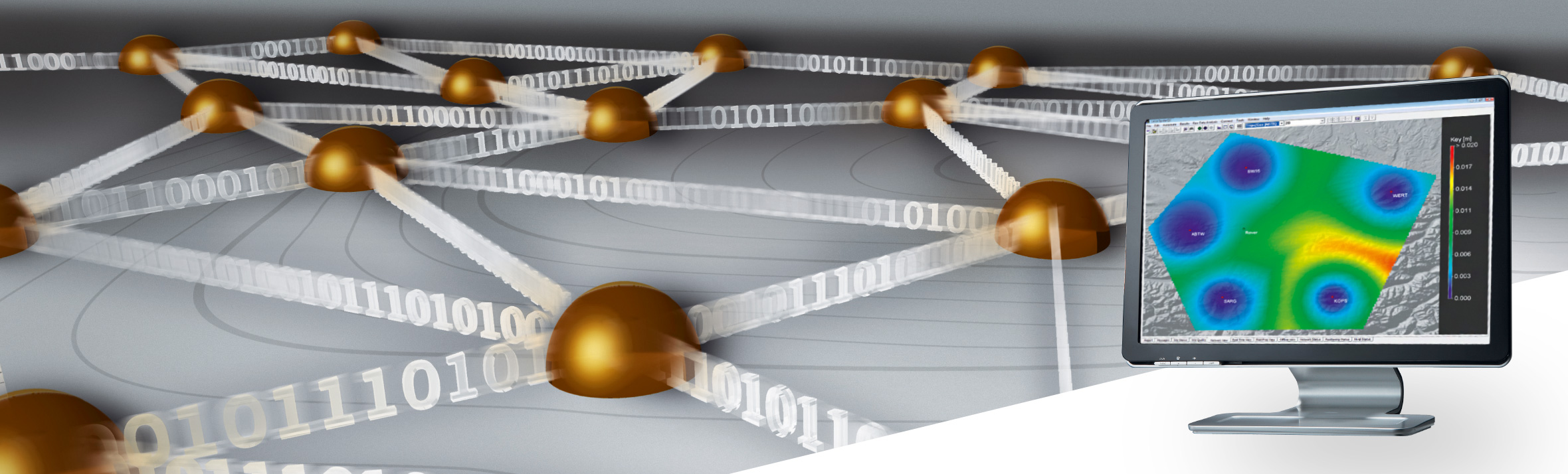
The Network Online Visualisation of Accuracy (NOVA) function allows you to visualise the spatial and temporal quality of single-base or network RTK positioning across your network. Real-time maps display the distribution of residual ionospheric and tropospheric/orbit errors, enabling you to monitor network status and identify problem areas. Innovative NOVA maps show the estimated level of residual error for mobile RTK users receiving network corrections or single reference station corrections (nearest site). NOVA maps allow network operators to measure the benefit of network corrections for their users and identify potential “hot spots”. Network users can view the maps online to ensure the quality of the corrections provided by the network and decide whether to use nearest-site or network RTK corrections for their specific survey location.
Reference station integrity monitoring
Using real-time positioning from Leica GNSS Spider or a fixed rover within your network, Leica SpiderQC can monitor the quality and availability of network corrections. Statistics on precision, accuracy, availability, reliability and more can be used to calculate service integrity and trigger alerts if predefined limits are exceeded, enabling corrective actions.
Deformation monitoring
Use Leica SpiderQC to detect and visualise movements of your reference stations or other critical infrastructure. Leica SpiderQC supports a wide range of high-speed real-time and post-processing positioning engines, including Leica GNSS Spider and Bernese, as well as any software compatible with standard NMEA and SINEX formats. The software combines to provide a flexible monitoring system for reference stations, bridges, dams, landslides and more. High-precision tilt measurements from Leica Nivel 210 tilt sensors can be used to complement GNSS-derived data. Longitudinal, transverse, X-axis, Y-axis, height, 2D and 3D displacements are calculated in real time and can be displayed on screen and on the web as time series, scatter plots and vector maps. Data filtering and archiving functions are also available.
Limit checks and messaging
Three levels of absolute limit checks can be defined individually for each monitored location for longitudinal, transverse, height, 2D and 3D displacements, 2D precision, height precision, availability, X-tilt and Y-tilt. A flexible messaging system allows email, SMS or command-line actions to be linked to each limit check and system message. The current connection and status of each location, sensor or solution is displayed using colour coding.
Industry-standard data formats
Leica SpiderQC works with industry-standard data formats such as RINEX (2.x, 3.x), SINEX, IONEX and NMEA GGA, GNS, GGQ and LLQ, in addition to Leica formats. It supports TCP/IP, serial and SQL database communication links. A direct link between Leica SpiderQC, Leica GNSS Spider and Leica SpiderWeb ensures fast and easy system configuration.